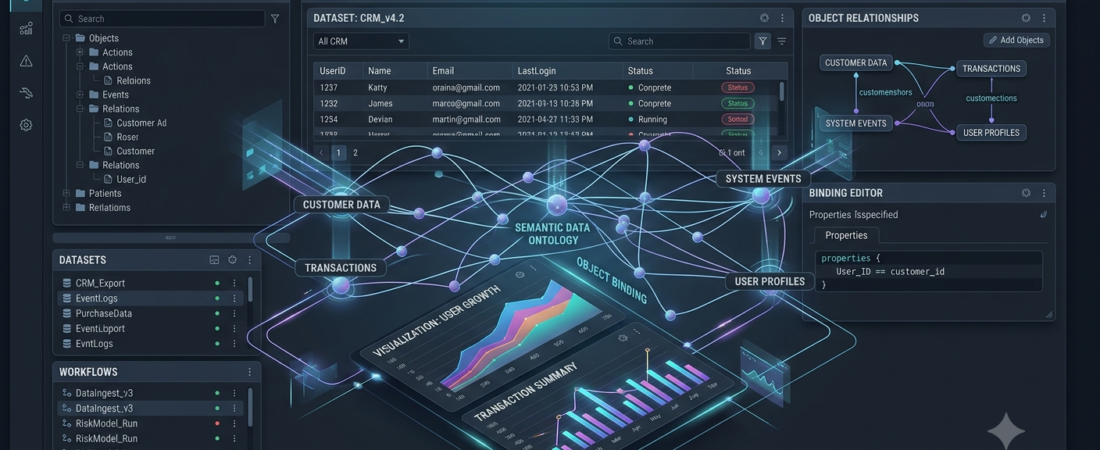
Building Your First Screen in Workshop: Widgets and Ontology Object Binding
Why Workshop matters
Workshop is a low-code UI builder that lets you build a screen through drag-and-drop with minimal code. The most common misconception is about visual polish — what actually determines whether a screen is done well isn’t widget placement, it’s the binding design: how data actually flows between widgets.
The widget composition flow
Workshop screens typically combine three widget types:
| Widget | Role |
|---|---|
| Filter List | Narrows an Object Set based on the conditions a user selects |
| Object Table | Displays an Object Set in a grid |
| Object View / Property Card | Shows the details of a selected object |
Layout widgets like Flex Layout, Tab, and Section build the responsive structure around them.
The ontology object binding mechanism
The binding mechanism follows this sequence:
- Object Set variable: The results of a Filter List are stored as an Object Set variable.
- Table binding: Connecting that Object Set variable to an Object Table means the table automatically updates whenever the filter changes.
- Active Object variable: Clicking a row in the table stores that object in an Active Object variable.
- Reflecting it on the detail screen: Binding the Active Object variable to a Property Card or Object View renders the clicked object’s details.
This architecture avoids reloading the entire dataset — only the bound variables that actually changed re-render, using the ontology’s indexed queries.
Common mistakes
- Vague variable names. Names like
var1orset2obscure what they’re actually for. A descriptive name likeactive_equipment_varmakes the screen much easier to maintain. - Skipping a data-flow sketch. Placing widgets first without mapping out what variables you’ll create and how they’ll flow tends to mean rebuilding later.
- Duplicating ontology ACL controls. Access control set on an Object Type already inherits down to Workshop widgets — you don’t need to redundantly rebuild permission logic at the screen level too.
What’s next
From here, look at Object Explorer for deeper object investigation, or Pipeline Builder to see the stage where the underlying data actually gets built.
FAQ
Q. Is Workshop “completely no-code”?
Most screens only need widget placement and binding, but anything with complex logic needs Functions. It fits the label “low-code” better than “completely no-code.”
Q. How do widgets connect to ontology objects?
Binding a widget to an Object Type’s Properties or to an Action Type is what reflects value changes and clicks on the screen back into real ontology data.
Q. Can multiple people use the same screen at the same time?
Yes, within their permission range — Workshop uses the ontology’s existing RBAC system for this.
Q. What’s the difference between Workshop and a BI tool?
A BI tool is focused on querying and visualization. Workshop can execute real business actions — approvals, status changes — through Action Types.
Q. What’s the most common mistake?
Building the screen before the ontology has stabilized. Any structural change means rebinding every widget, so it works out better to start Workshop only after the ontology has settled.