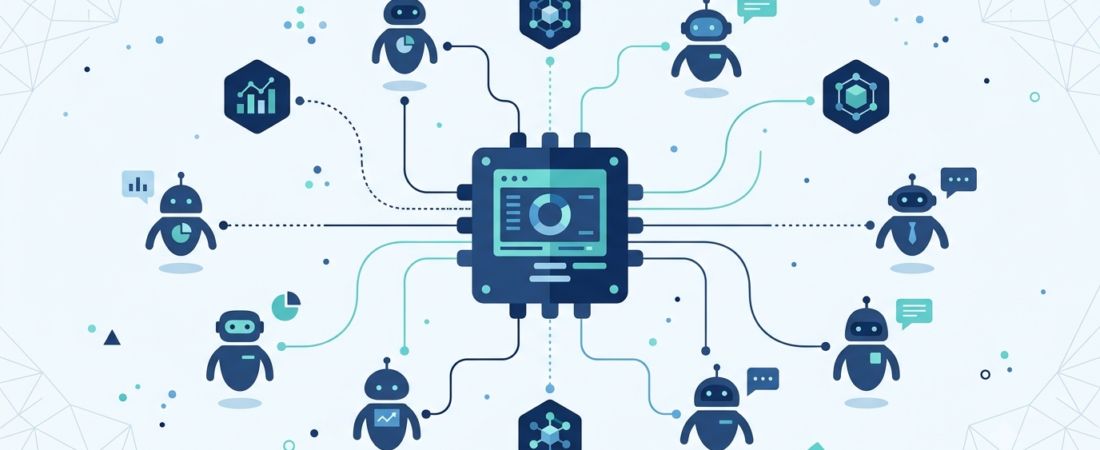
Agents (Part 1), context engineering (Part 2), harnesses (Part 3), and agentic engineering (Part 4) — everything this series has covered so far assumed a single agent. This time we break that assumption and look at the structure where multiple agents split up and handle one task together.
Why One Agent Stops Being Enough
Pushing a single agent to keep carrying a task usually hits a wall in one of two places.
- Context overload — research results, intermediate code, and prior conversation all pile up in the same context window, blurring out the information that actually matters right now (a limit of context engineering covered in Part 2).
- Role conflict — when the same agent that writes code also verifies that code, it develops a bias toward passing its own work.
A multi-agent system solves both problems by splitting the work and separating the context. Research happens inside a research agent’s own context; code verification happens inside a separate verification agent’s context.
The Basic Structure — Orchestrator and Subagent
There’s one structure that shows up almost everywhere.
| Role | What it does |
|---|---|
| Orchestrator | Splits the task, delegates pieces to each Subagent, gathers the results, and decides what to do next. It’s the one that talks directly to the user. |
| Subagent | Handles only the narrow piece of work it was delegated. Has its own independent context window. Returns just the result to the Orchestrator when done. |
The key point is that a Subagent has an independent context. All the tokens a research Subagent burns through digging into 100 documents never touch the Orchestrator’s context — the Orchestrator only receives the summary the Subagent hands back. This keeps the Orchestrator’s context relatively clean, so it’s less likely to lose track of “what was I even doing” as the overall task grows longer.
Parallel vs. Sequential Execution
How you run Subagents depends on the nature of the task.
| Mode | Good fit | Watch out for |
|---|---|---|
| Parallel | Independent research tasks (e.g. comparing 3 libraries at once) | Subagents editing the same file at the same time will collide. Best applied to research/read-only work first. |
| Sequential | Tasks where one step’s output feeds the next (e.g. design → implement → verify) | The Orchestrator has to review the result and issue the next instruction at every step, which adds round-trip overhead. |
In practice, most real work mixes both — for example, “research several candidate approaches in parallel, then pick one and implement it sequentially.”
Failure Patterns You’ll Run Into in Practice
Switching to multi-agent doesn’t automatically make things better. Here are the failures that show up most often.
- Over-splitting — breaking a task into Subagents when it didn’t need to be split costs more time and money in round-trip instructions and result-gathering than it saves. Only split at the point where context actually becomes a real burden.
- Context loss — if the summary a Subagent hands back to the Orchestrator is thin, the Orchestrator loses track of what it even delegated in the first place. Define the Subagent’s return format clearly.
- Hidden dependencies — running tasks in parallel that actually needed to be sequential means Subagent B starts working on the assumption that Subagent A already finished, when it hasn’t.
- Unverified merging — if the Orchestrator merges multiple Subagents’ results without review, individual Subagents’ errors flow straight into the final result.
When You Actually Need Multiple Agents
Not every task needs a multi-agent setup. The test is simple.
- Does a single agent’s context window actually run short (broad research scope, lots of files to juggle)?
- Does splitting roles clearly improve result quality (the classic case: separating writer from verifier)?
- Does the time saved by running part of the work in parallel outweigh the extra orchestration cost?
If none of those apply, it’s better not to split at all. In practice, a single agent with good context engineering (Part 2) is enough for more tasks than you’d think.
Wrapping Up
- Multi-agent systems exist to solve context overload and role conflict.
- An Orchestrator splits work and delegates to Subagents; each Subagent handles a narrow scope in its own independent context and returns just the result.
- Run independent work in parallel, and work with real dependencies sequentially.
- Over-splitting and sloppy result-merging are the most common causes of failure.
- If context isn’t actually a real burden for the task, don’t bother splitting it.
AI Agent Series — Full Table of Contents
- (1/6) What Is an AI Agent?
- (2/6) Prompt Engineering vs. Context Engineering
- (3/6) What Is Harness Engineering?
- (4/6) Agentic Engineering and the PH-AH Loop
- (5/6) Setting Up an AI Agent Practice Environment
- (6/6) Hands-On Practice With 4 AI Agent Concepts
This article isn’t a direct sequel to that 6-part series, but it pairs well with it: Building an MCP Server: Connect Claude to Your Internal Systems