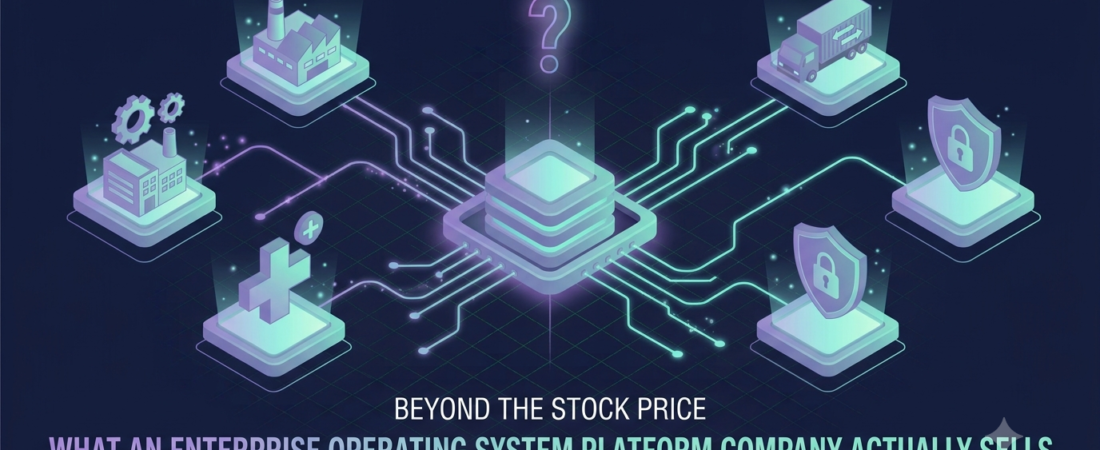
One thing up front: this article isn’t about Palantir’s stock price or an investment call. This blog doesn’t cover investing at all. Instead, for readers who landed here by searching “Palantir,” this is a practitioner’s explanation of what the company actually builds and sells.
The short version: Palantir is less an “AI company” than a platform company that organizes an enterprise’s data into a form software and AI can actually understand. It started from the observation that no matter how good the model you bolt on, AI won’t work reliably on top of company data without that organizing step first.
Palantir Doesn’t Sell “One Product”
Palantir’s core product line splits into two branches: Gotham, built for government, defense, and intelligence customers, and Foundry, built for commercial enterprises. This blog focuses mainly on Foundry. Foundry isn’t really a single piece of software — it’s closer to a bundle of applications, all inside one platform, that carries you from connecting data, through building pipelines, to analysis, building applications, and wiring in AI.
What Palantir is actually selling here, at its core, isn’t the software itself — it’s a concept called the Ontology. An Ontology reorganizes data scattered across a company’s many systems back into the actual business terms and relationships people use day to day. Without that map, neither software nor AI can understand the real flow of the business — “a customer places an order,” “inventory moves out of a warehouse.”
Why This Map Is Worth Money
Most companies already have their data. It’s sitting somewhere in an ERP, a CRM, an internal database. The problem is that this data is scattered across systems under different names and different formats, and the “meaning” connecting it all was never documented. Bolt even a great LLM onto that mess, and the AI ends up guessing at column names — it can’t reliably produce accurate answers.
Palantir has been working this exact problem for a long time. Founded in 2003, it spent over two decades organizing messy, complex data in government and defense settings so it could actually be used for decisions. Foundry is what made that experience applicable to commercial enterprises, and over the past few years the company layered AIP (AI Platform) on top — a way to connect LLMs to that same foundation safely.
FDE — The Other Axis for Understanding Palantir
If you only look at Palantir through its products, you’re seeing half the picture. The other axis is a staffing model called the FDE (Forward Deployed Engineer). Palantir doesn’t just sell software and walk away — engineers embed directly with the customer and work alongside them to actually organize that company’s data and workflows into an Ontology. This is why Palantir often gets described as “a software company that behaves like a consulting firm.” It’s also part of why licensing costs run high.
So What Actually Sets It Apart From Competitors
Plenty of companies claim to be data-integration or analytics platforms. Snowflake and Databricks, for instance, keep expanding from storage and analytics into AI integration too. The real difference between those companies and Palantir comes down to how central the Ontology is to the product. Palantir doesn’t stop at storing and analyzing data — it builds a semantic layer (the Ontology) on top, builds real operational applications on top of that structure, and has designed AI from the start to work directly against that same structure.
Ontology and knowledge-graph specialists like Stardog and Timbr.ai, and larger platforms like Microsoft Fabric, are moving in a similar direction. That tells you two things at once: this market hasn’t standardized yet, and it’s a real enough problem that multiple companies are racing to solve it at the same time.
Bottom Line — Judge It by What It Solves, Not the Stock Price
Again, this isn’t a buy-or-sell call on Palantir stock. But if you landed here by searching “Palantir,” the point worth taking away is that what the company actually does isn’t a flashy AI demo — it’s giving enterprise data meaning so that software and AI can actually operate on top of it. That underlying problem applies to every company, whether or not they ever adopt Palantir.
Further Reading
For a closer look at why this approach matters in practice, and how to think about licensing cost, see Choosing an Enterprise Data Platform — Why Palantir. If you’re curious about the AI layer built into Foundry, read What Is AIP (AI Platform)?. And for a full picture of Foundry’s architecture, see Palantir Foundry Architecture Overview: From Connect to AI in Five Layers.