So far this series has covered the basics of an AI agent, prompt and context engineering, and harness engineering. This article covers the collaboration style itself — how you actually use all of this to produce high-quality output.
What Vibe Coding Is, and What’s Wrong With It
“Vibe coding” refers to the attitude of having AI generate code and just using it, without ever trying to understand how it works. The core issue isn’t speed — it’s the attitude of “forgetting the code even exists.”
The problem is that even when the output looks plausible right now, nobody can fix code nobody understood in the first place once something goes wrong later. If there’s a hidden bug in logic AI produced, it takes longer to even notice, because nobody reviewed it to begin with.
Agentic Engineering — Split the Roles, and Always Review
Agentic Engineering is the opposite-direction answer to this problem. The core principle is simple.
- AI’s role: produce a draft quickly
- The human’s role: set the design direction, and always review what AI produces
The difference from vibe coding is that instead of “forgetting the code exists,” a person always reviews what got produced, together with the AI. Speed comes from AI; final responsibility for quality stays with the person.
What’s interesting is that this principle never becomes obsolete no matter how far AI models advance. As models improve, technical scaffolding like harness engineering can genuinely shrink — but the principle that “a person controls direction and quality, and holds final responsibility” doesn’t change no matter how good the model gets.
The PH-AH Loop — a Person Confirms Both the Plan and the Action
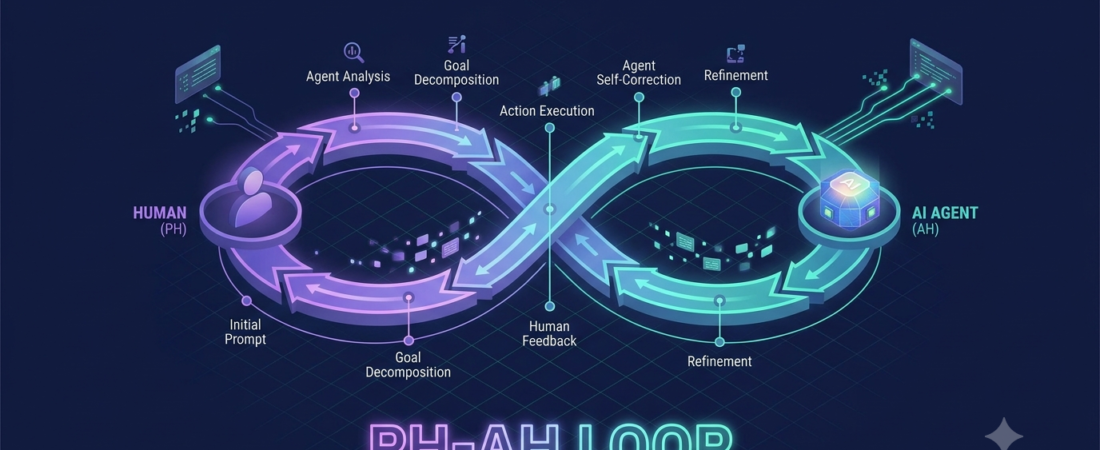
The structure that puts agentic engineering into practice, repeatedly, is called the PH-AH loop — a cycle where a person steps in at every Plan and Action stage.
Step 1 — Plan (+ Human-in-the-loop) AI drafts a plan first. It presents “I’ll build it in this order, this way” to the person and asks for confirmation. The person reviews the plan, discusses it with the AI, requests changes if needed, and confirms it.
Step 2 — Action (+ Human-in-the-loop) AI executes according to the confirmed plan. Once execution finishes, it shows the result to the person again and asks for confirmation. The person reviews the result, communicates with the AI to make changes if needed, and confirms it.
These two steps repeat until the task is done: confirm one plan → confirm one action → confirm the next plan → confirm the next action. The key is that it never moves to the next step without human confirmation.
Why This Loop Raises Output Quality
Skip human involvement at the planning stage and hand AI both planning and execution at once, and you only discover a problem after it’s already gone far down the wrong path. Undoing that is expensive.
The PH-AH loop breaks that cost down into small pieces. If the direction is wrong at the planning stage, you catch it before execution ever starts; if an execution result doesn’t match expectations, you fix it before moving on to the next plan. Catching and fixing problems as early and as small as possible is what drives up final output quality.
Applying This in Practice — How Much Should You Actually Review?
Try to review everything, and you lose the whole point of using AI in the first place. In practice, it’s more efficient to decide up front which parts genuinely need review and which parts you can just glance at the result of.
Building a web screen, for example: the part users see directly (the frontend) is often fine to check visually, just by looking at the result. The logic that processes data (the backend), on the other hand, can hide internal bugs even when nothing looks wrong on the surface — so it’s safer to have a person actually review that code.
In other words, the real starting point of agentic engineering isn’t “review everything AI produces” — it’s deciding in advance what needs review and what doesn’t.
Wrapping Up
| Vibe Coding | Agentic Engineering | |
|---|---|---|
| Attitude toward code | Use it as-is, without understanding it | Always review and understand it before use |
| The human’s role | Only checks the final result (or doesn’t even do that) | Reviews and confirms at every planning and execution step |
| Repeating structure | None — receive the result once and you’re done | The PH-AH loop — confirm Plan, then confirm Action, on repeat |
| Where responsibility lies | Unclear | The person holds final responsibility for quality and direction |
Across four parts now, this series has covered AI agents, prompt/context engineering, harness engineering, and agentic engineering in order. The next article puts all four concepts into practice with a hands-on scenario.
AI Agent Series — Full Table of Contents
- (Part 0, before you start) Setting Up an AI Agent Practice Environment
- (1/5) What Is an AI Agent?
- (2/5) Prompt Engineering vs. Context Engineering
- (3/5) What Is Harness Engineering?
- (4/5) Agentic Engineering and the PH-AH Loop — you are here
- (5/5) Hands-On Practice With 4 AI Agent Concepts
Beyond the series — the two articles below aren’t part of this 5-part series, but pair well with it.