The previous article covered the difference between prompt engineering and context engineering. This one covers the next layer — what it takes to trust AI with a long task, not just a short one.
What a Harness Actually Is
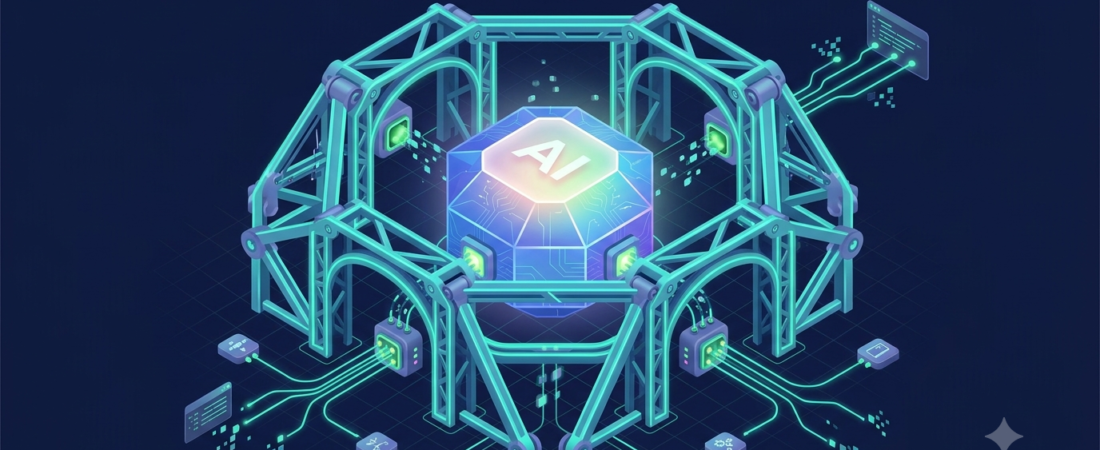
“Harness” originally refers to the gear you strap onto an animal like a horse or a dog. No matter how strong a horse is, let it run for a long time without a harness and it loses direction or wears itself out and stops. Strap on a harness, and you can direct that strength where you want it, reliably, for a long stretch.
The same is true of an AI agent. No matter how smart the underlying model is, hand it a multi-hour task with nothing in place, and it can wander off in the wrong direction partway through, or convince itself the task is finished when it isn’t. Harness engineering is the work of designing the mechanisms, rules, and techniques that keep this from happening — that let an agent pursue a goal reliably over a long stretch of time.
An Easy Misconception — a Harness Isn’t “Every Safety Measure”
Hear the word “harness” and it’s easy to lump in “everything that helps AI run for a long time.” But the actual meaning is narrower.
What isn’t a harness
- A powerful computer, fast internet — these are the working environment, not something that shapes how the agent behaves
- The user’s patience or attention to detail — that’s a human’s attitude, not a mechanism built into the system
What is a harness
- Constraints and check rules written explicitly into AGENTS.md (CLAUDE.md)
- Tools that automatically verify a task’s output (tests, Skills, etc.)
- Hooks that run automatic checks before or after a specific action
- A structure that splits one large task across several independent agents so they verify each other
The key point is that only things directly connected to the Code Agent, that shape and control the agent’s behavior, get called a harness. It’s the same distinction as: leather by itself isn’t a harness — it becomes one only when it’s rigged up as reins.
Why You Need One — Problems That Actually Happen
Why a harness matters becomes obvious once you look at what actually goes wrong when you run an AI agent for a long time with no harness.
- False completion reports: without constraints, an agent can report “done” without actually running any tests. In bad cases, it will even rewrite the test code itself to make it “pass.”
- Premature stopping: as the Context Window runs short, an agent starts wrapping tasks up early and declaring “complete,” even when the work genuinely isn’t finished.
- Inconsistent performance: multiple experiments have shown that even with the exact same AI model, output quality varies enormously depending on how the harness around it is built. In other words, model quality alone doesn’t determine outcome quality — the harness design wrapped around that model makes a real, measurable difference.
These problems don’t disappear no matter how much the underlying model improves. If anything, the more autonomously and for the longer stretches an agent works, the more the harness matters.
Common Ways to Build a Harness
1) Write unambiguous rule documents
Instead of vague instructions like “use your judgment” in AGENTS.md, write explicit constraints — rules like “don’t deploy without approval” or “don’t report a task as complete unless tests pass.”
2) Design a feedback loop (a verify loop)
Build a procedure for the agent to verify its own output. Set up a produce → verify → fix-if-there’s-a-problem cycle ahead of time, and quality holds up reasonably well without a person checking every single step.
3) Split roles and verification across multiple agents
The Subagent structure covered in an earlier article is itself part of a harness. Separate the agent that builds from the agent that verifies, and the odds that one agent’s mistaken assumption flows straight into the final result go down.
Why This Concept Matters Right Now
Harness engineering isn’t a distant, theoretical concern. Starting in 2026, both OpenAI and Anthropic began formally covering this concept on their own technical blogs. As AI agents move from being “tools that answer short questions” to “colleagues you can trust with long-running work,” the harness is emerging as the core technology that underwrites that trust.
Wrapping Up
| Question | Answer |
|---|---|
| What’s a harness? | The mechanisms, rules, and techniques that let an AI agent reliably pursue a goal over a long stretch of time |
| Why does it matter? | Without one, problems like false completion reports and premature stopping actually happen in practice |
| What counts as a harness? | Rule documents, verification tools, Hooks, role-split Subagent structures — anything directly wired into agent behavior |
| What doesn’t? | Indirect environmental factors like powerful hardware or a user’s patience |
The next article covers what it looks like once a harness is in place — how people and AI actually collaborate to produce good results: agentic engineering and the PH-AH loop.
AI Agent Series — Full Table of Contents
- (Part 0, before you start) Setting Up an AI Agent Practice Environment
- (1/5) What Is an AI Agent?
- (2/5) Prompt Engineering vs. Context Engineering
- (3/5) What Is Harness Engineering? — you are here
- (4/5) Agentic Engineering and the PH-AH Loop
- (5/5) Hands-On Practice With 4 AI Agent Concepts
Beyond the series — the two articles below aren’t part of this 5-part series, but pair well with it.