Palantir Is Expensive. Here’s Why We Use It Anyway
Summary
Whether Palantir is the right choice for an enterprise data platform comes down to three questions: do you need an integrated platform, does the problem actually go away just because LLMs got better, and do you have the internal capability to build an ontology yourself? For organizations that need to unify everything from integration to AI on one platform — instead of stitching together separate tools — and that can afford to invest in ontology design, the total-cost-of-ownership (TCO) case gets stronger.
Who this is for
Palantir is expensive. I’m not going to pretend otherwise. This is for practitioners and decision-makers evaluating enterprise data platforms. It’s not investment advice or a stock price take — it’s a procurement/architecture take on “what standard should you actually judge licensing cost against.”
I hear constantly that Palantir’s licenses are expensive. Even so, here’s how I, someone actually running the operating organization, think about why it’s still worth considering.
Criterion 1 — integrated platform, or a pile of separate tools?
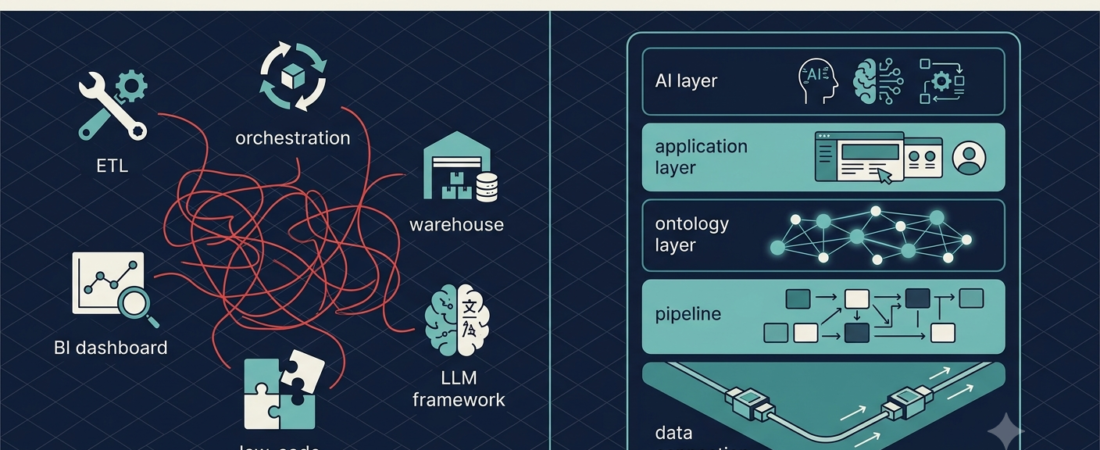
Foundry handles data extraction, transformation, analysis, application (screen) building, writeback through Actions, and attaching an LLM directly on top via AIP — all inside one platform.
What if you picked a specialized product for each of those areas instead and stitched them together? If you actually build that out, it looks like this:
| Area | Representative products | What you need |
|---|---|---|
| Extract/Load | ETL/ELT tools like Fivetran, Airbyte | Connector licenses, pipeline management |
| Orchestration | Airflow, Dagster, etc. | Separate infrastructure to operate |
| Storage/semantic layer | Snowflake/Databricks + dbt | Design your own modeling rules |
| Visualization/dashboards | Tableau, Power BI | Another license |
| Application builder | Low-code tools like Retool | Build the screen-to-data connection separately |
| AI/LLM orchestration | Frameworks like LangChain | Wire up integration with internal data yourself, by hand |
Looking at any single piece in isolation, some of these products are actually better. The problem shows up once you bolt them all together. IDC’s 2025 survey found the average number of AI software vendors at companies with 1,000+ employees was 11.4 — up sharply from 4.2 in early 2024. Zapier’s survey of 500+ companies found 70% hadn’t gotten past “basic integration,” and three-quarters said they’d already experienced negative outcomes from “disconnected AI.” The numbers themselves show that DIY-ing an AI environment is a far harder road than it looks.
Criterion 2 — better LLMs don’t mean the problem is solved
You might think: “LLMs have gotten this good — can’t we just wire up internal company data through MCP and analyze it?” That’s not so simple either, because there’s no context between tables.
Say you hand an LLM two tables like EKKO and EKPO (SAP’s purchase-order header and item tables) with nothing but schema and column descriptions. The LLM has no way to know which key to join them on, why WERKS (plant) might be legitimately empty in certain situations, or whether a particular combination of status values is actually valid from a business standpoint — the “implicit business rules.” Handing it field descriptions and table definitions along with the schema doesn’t make this problem go away.
This is actually borne out by recent research. A 2026 study that built a clinical Q&A system on an ontology-based knowledge graph (RDF/OWL) found that a plain LLM’s hallucination rate on the same questions was 63% — and dropped to 1.7% once the ontology grounded the answers. Simply handing over a schema description and structuring relationships and meaning through an ontology produce different results. This is exactly where an ontology becomes necessary — getting meaningful, traceable answers requires structure that goes beyond the level of a table definition.
Criterion 3 — can you build the ontology yourself?
Even if you agree you need an ontology, it might seem like it doesn’t have to be Palantir specifically. You could train metadata onto an existing RDB, or build a semantic layer directly on top of a graph DB. But doing this well isn’t easy with internal capability alone — ontology design is its own specialized discipline, and getting it wrong reproduces exactly the kind of naming collapse covered elsewhere on this blog.
There’s also a growing crowd of vendors benchmarking themselves against Palantir and pitching “productized ontology” — semantic-layer startups like Stardog, Timbr.ai, and Galaxy, and even Microsoft’s Fabric IQ. In 2026, the industry has started calling this the “enterprise ontology race.” But Palantir has been working this space for over a decade — over two decades company-wide, counting from its 2003 founding. During that time it’s accumulated real experience building ontologies across industries — manufacturing, finance, defense, healthcare — along with the hands-on FDE (Forward Deployed Engineer) methodology for actually building them in the field. Late entrants pitching the same concept as a product doesn’t easily substitute for that accumulated know-how and build methodology.
To sum it up: for an organization that actually wants to put internal data to work in decisions, Palantir — with an integrated platform already wired to AI plus real ontology know-how — is still a realistic option.
Judging it on total cost of ownership
Even after laying out these criteria, justifying an expensive license clearly comes down to running the total cost of ownership (TCO) numbers. In practice, I think these are the line items worth putting side by side:
- License cost vs. the hidden cost of managing 11+ vendors individually (integrated maintenance, security/compliance work, SOC 2 review per vendor, etc.)
- The initial learning curve vs. the cost of undoing a badly designed ontology later
- Spend right now vs. the compounding effect of applications, analysis, and AI use that accumulate on top of an ontology once it’s set up correctly
Whether you treat this as a short-term cost or a long-term asset you’re building ultimately depends on your organization’s priorities — I lean toward the latter. It’s because you’re not rebuilding from scratch for every new project; you keep building on top of an ontology you already have.
When this reasoning doesn’t apply
This reasoning doesn’t apply to every organization. A collection of individual tools may be more sensible than an integrated platform if:
- You have a single data source and simple analysis needs. An integrated platform’s benefit grows as you unify more systems under one view. With a single source, that benefit shrinks.
- You’re already deeply invested in a specific tool stack. If you have significant existing pipeline and dashboard assets, switching costs can outweigh the integrated platform’s benefit.
- Your AI use stays at the level of document summarization or coding assistance. At that level, a general-purpose LLM API is enough, and the need to build an ontology is relatively low.
Last word
It doesn’t have to be Palantir specifically. But the underlying skill of building and using an ontology is becoming a necessary piece of any real attempt to connect enterprise data to AI properly. A few years from now, AI might handle this whole process for you. But right now, to actually use AI well today, this step is still required.
FAQ
Q. LLMs keep getting better — why do we still need a separate structure like an ontology?
Even a smarter model on its own doesn’t solve the problem of not knowing your company’s specific, current data state and permission structure. An ontology is the layer that structurally solves that problem, independent of model capability.
Q. What’s the real difference between piecing together individual tools and using an integrated platform?
Disconnected tools tend to lose meaning and lineage as data moves between systems, and each tool needs its own maintenance staff. An integrated platform reduces that cost at the price of higher dependency on one vendor.
Q. If we don’t have the capability to build an ontology ourselves, can we still use Palantir?
Early on, you can build with FDE (Forward Deployed Engineer) support. Long-term, though, your investment only keeps paying off if internal staff can maintain and extend the ontology themselves.
Q. Is Palantir always cheaper from a TCO standpoint?
No. The license cost itself is often not low, and for organizations with small data footprints or low integration needs, a collection of individual tools can actually be cheaper.
Q. When does this reasoning not apply?
For low-integration, low-reuse cases like simple single-department reporting, or when an organization has no internal capacity to invest in an ontology at all, lighter-weight tools may fit better than Palantir.