Starting From a Single Churn-Risk Customer Click
“Check whether any of the customers with a recent spike in support tickets are at risk of churning.” Where do you even start with a request like that? Instead of writing a SQL join, you can open Insight and start by clicking on a single customer Object.
What Insight Actually Does
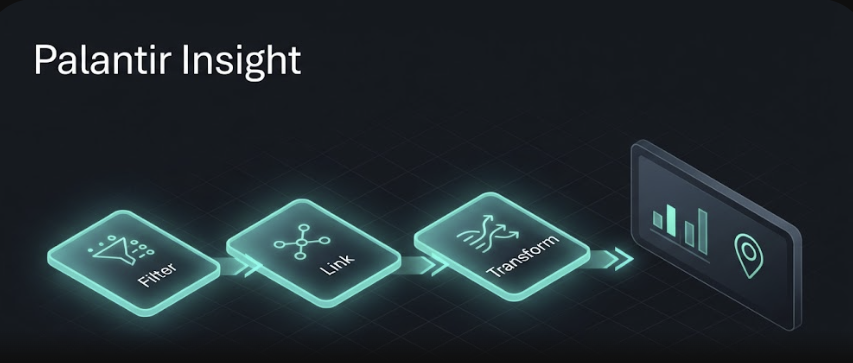
Insight is a code-free exploration tool built on your Ontology’s Object Types and Link Types. You build an analysis path by chaining Filter, Link, and Transform cards in sequence.
For a churn-risk investigation, that might look like this:
- Filter card: Keep only customers with 5+ support tickets in the last 30 days.
- Link card: Traverse to the connected “Contract” Object. Keep only customers whose contract is nearing expiration.
- Transform card: Sort the remaining customers by ticket count.
Every step is a click, no code involved. And an intermediate result — say, “customers with a ticket spike and an expiring contract” — can be saved as its own set and reused in other Foundry applications.
Six Core Capabilities of Insight
- Analysis paths: Save the filter/join flow you’ve built so far as a reusable set.
- Link traversal: Follow relationships to connected Objects while filtering and pivoting.
- Set operations: Combine different analysis results with union, intersection, and difference (e.g., the intersection of “ticket-spike customers” and “payment-delayed customers”).
- Visualization and mapping: Filter using distribution charts, histograms, and geographic data.
- SQL queries: Write a query directly when you need more precise analysis.
- Data writeback: Handle an anomaly you find mid-investigation immediately with an Action (e.g., running an “assign account owner” Action on this customer).
The real value of Insight shows up at the end of a churn-risk investigation, when you can immediately run an Action to flag the five highest-risk customers you found for “urgent care” — right there, in the same screen where you found them. Investigation and action happen in one place.
When to Use Insight vs. Other Tools
Foundry has several tools that look similar at first glance, which makes it easy to get confused about which to reach for.
| Tool | Strength | When to use it |
|---|---|---|
| Insight | Link-based visual exploration | Investigating a question that just came up, on the spot |
| Object Explorer | Ontology search and entry point | Starting to explore data for the first time |
| Quiver / Contour | Deep time-series and statistical analysis | Doing a formal, deep analysis of structured data |
| Workshop | Custom operational screens | The same investigation gets repeated regularly by multiple people |
If you’re investigating churn risk “once, today,” Insight is the right tool. If the whole sales team ends up running this same investigation every week, that’s the signal to turn the same logic into a fixed Workshop screen instead.
Three Mistakes Beginners Commonly Make
Forcing a recurring operational screen into Insight. Insight is optimized for on-the-spot investigation. If a screen needs to be checked weekly, move it to Workshop.
Not saving and sharing intermediate results. If you build a useful set like “ticket-spike customers with an expiring contract” and don’t save it, you have to redo the same investigation from scratch next time.
Not checking writeback permissions ahead of time. Discovering you don’t have permission right as you try to run an Action mid-investigation breaks your flow. Check what Actions you’re actually allowed to run before you start.
Using It Alongside an LLM
Ontology-based exploration through Insight carries lower hallucination risk than vector-based RAG, because the schema and relationships are already defined — an LLM searching and querying only ever moves across a verified structure. That said, “Ontology-structure-based LLM exploration” isn’t an official term; it’s a description that’s become common in practice, not a formal spec.
Frequently Asked Questions
Q. Should I learn Insight or Workshop first? If you do a lot of on-the-spot investigation, start with Insight. If you already have a recurring operational screen, start with Workshop.
Q. Can I hand off results from Insight to Quiver or Contour? Yes. A common workflow is doing a first-pass filter in Insight, then continuing into deeper time-series or statistical analysis in Quiver or Contour.
Q. Does an Insight screen update in real time? The underlying data updates on your pipeline’s schedule, so how close to real-time it is depends on that pipeline’s refresh cadence.
Q. Can multiple people view the same Insight investigation? Yes — you can share it through Compass’s permission system, and each user’s accessible data range is automatically restricted based on their own permissions.