Who This Article Is For
The chatbot pilot went smoothly. Then, right before a company-wide rollout, it just stopped. This is for anyone who’s run an internal chatbot pilot and hit a wall at the actual deployment stage — or a practitioner who just got asked, “let’s build a chatbot on our company data too.”
Personal-Productivity AI Succeeded. Why Doesn’t the Next Step?
What Is Palantir Ontology? described an Ontology as “a map that translates a company’s reality into a form software and AI can understand.” This article looks at why that map matters, through a wall many companies actually run into: the limits of chatbot-style enterprise AI.
These days, companies are adopting personal-productivity AI — coding assistance, document summaries, meeting-note cleanup — quickly and successfully. That’s because this territory only requires what LLMs are actually good at: language. Code and documents are both, in the end, just text.
The trouble starts at the next step. “An AI you can ask about our company data and it just analyzes it for you” is an entirely different game. A huge number of companies stall out at the pilot stage right here.
The Real Reason Enterprise AI Stalls at the Chatbot Stage
It’s easy to chalk this stall-out up to “the model still isn’t good enough,” but the real cause is usually somewhere else. It breaks down into three things.
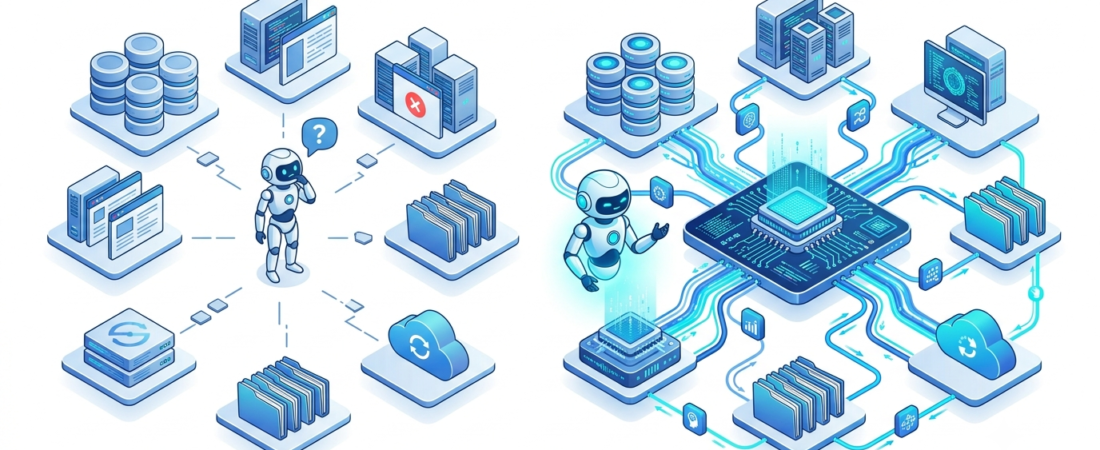
First, data is scattered across multiple systems. ERP, CRM, and internal document stores all exist independently, and even the single concept of “customer” has a different name and format in each one.
Second, the “meaning” of tables and columns was never defined. A name like TB_CUSTOMER or CUST_ID alone tells neither a person nor an AI exactly what it means.
Third, even when you find an answer, it doesn’t lead to an actual action (approval, execution, applying the change). There’s a large gap between seeing an analysis result in a chat window and having that result actually processed inside an operational system.
Gartner has projected that by 2026, 60% of AI projects that lack “AI-ready” data will be abandoned. The center of gravity for this problem sits on the data side, not the model side.
The Most Common Failure Pattern: Bolting RAG Onto Internal Documents First
The first thing most companies try is bolting Retrieval-Augmented Generation (RAG — retrieving documents and feeding them to the LLM alongside the question) onto internal documents. It looks pretty convincing at the demo stage.
A typical RAG pipeline flow
Internal documents/DB → Retrieval → injected into LLM context → answer generated
Nowhere in this flow is there any definition of what a column or code value likeTB_CUSTOMERorCUST_IDactually means in the real business.
The problem surfaces the moment it’s deployed for real use. The LLM only “guesses” at column names like TB_CUSTOMER or CUST_ID from context — it doesn’t actually know what they mean in the business, or what exceptions apply. A demo can slide past this; a real practitioner spots the wrong answer immediately.
This is a problem we’ve genuinely run into ourselves. Back when generative AI first appeared, we assumed we could get it to answer business questions directly, and approached it that way. When we didn’t get the results we wanted, we categorized questions into types, built sub-queries per business area, built a general-purpose union table spanning them all, and wrote orchestration to route each question to the right query. We even trained separate metadata to help it understand the tables — and still didn’t get satisfying answers. Looking back, what we actually did was endlessly generate one query after another for one question after another.
What’s Fundamentally Different Between RAG and an Ontology
| Plain RAG | Ontology-based | |
|---|---|---|
| Meaning of columns/tables | LLM guesses from context | Predefined in business terms |
| Relationships between tables | Rediscovered via a new query every time | Traversed along predefined Links |
| Consistency of answers | Same question can be answered through a different path each time | Relatively consistent, following the same relationship structure |
| Executability | Provides an answer only; execution needs a separate system | Can flow straight into execution via an Action Type |
| Upfront build cost | Low (can start with just documents) | Higher (needs Ontology design and maintenance) |
The point of this table isn’t “an Ontology is always better.” RAG’s low upfront cost still makes it valid for territory with relatively low accuracy requirements, like document-based Q&A. The problem only shows up when a team tries to make RAG alone solve a situation that requires handling company data accurately, repeatedly, and all the way through to execution.
Where the Fix Points: Not a Better Model, but Semantic Structure First
RAG stops at “guessing” a column’s name because nothing anywhere tells it what that column actually means in the first place. So the direction has to change. Not “use a bigger model” — give the data a semantic structure first. There’s more than one way to build that structure — knowledge graphs, data catalogs, business glossaries, alongside the Ontology — and this article focuses on the Ontology. An Ontology defines technical names like TB_CUSTOMER and CUST_ID in business terms — Customer, Customer ID — and pre-organizes the relationships between tables into a form people understand, like “a customer places an order.”
With that map in place, AI stops guessing at column names and instead follows already-defined objects and relationships to find its answer. And if that answer is connected to an “Action” defined on top of the Ontology, it can go beyond a simple response and flow through to real work — approval, execution.
The Ontology we currently operate hasn’t grown to cover every area yet, but inside the areas that are well-defined, meaningful analysis is already happening on top of the relationships and modeling already built. Whether that’s because the LLM itself got better, or because the modeling is solid, isn’t something we’ve cleanly separated out yet — that’s something we plan to keep examining.
When Investing in an Ontology Is Justified
An Ontology isn’t free, of course. It comes with governance questions — who designs it, who maintains it, how it gets updated as the business changes. Here’s how to judge it.
- If all you need is to pull a handful of reports, this level of structure can be overkill.
- If AI needs to handle data scattered across multiple systems continuously and accurately, the investment is worth much more.
- If the answer needs to lead to a real business action (approval, execution), an Ontology’s Action Type is close to the only practical way to make that connection at all.
Common Failure Patterns in Practice
- Swapping in a bigger model when RAG doesn’t work: if the root cause is a missing semantic structure in the data, switching models alone just reproduces the same problem with a different model.
- Endlessly adding queries per question type: as in the failure experience covered above, continually adding a new query for each new question doesn’t scale. Predefining relationships in an Ontology fixes this problem structurally, at the root.
- Equating pilot success with company-wide deployability: a chatbot that worked well for one department or one type of question often sees its error rate spike once it’s expanded company-wide — because data outside the pilot’s scope never got the same level of semantic structure.
Wrapping Up
Enterprise AI stalling at the chatbot stage isn’t about the model falling short — it’s that the data hasn’t been given meaning yet. An Ontology is a practical way to close that gap, and the “map that translates a company’s reality,” covered in What Is Palantir Ontology?, is exactly where it proves its worth.
Reference: Gartner press release, “Lack of AI-Ready Data Puts AI Projects at Risk” (2025-02-26), among other forecasts on AI-ready data (Gartner material requires login to view)
What to Read Next
For how this problem gets solved at the platform level, see Choosing an Enterprise Data Platform. For what actual Ontology design looks like, see Ontology Core Components: Object, Link, Action Type, and Functions Explained.