Why This Comparison Matters
Browse Palantir job postings or articles for a while and an unfamiliar title keeps showing up: “FDE (Forward Deployed Engineer).” If you’ve spent years on ERP or consulting projects, seeing this role might make you wonder, “isn’t this basically a PI (Process Innovation) Consultant?” or “isn’t this a Solution Architect?” All three roles do share the common ground of working between the business side and the technology — but what they actually produce, and how far their responsibility extends, differ quite a bit.
This article draws on real experience working alongside FDEs while running a Palantir operations team, and lines up the FDE role next to the PI Consultant and Solution Architect roles familiar from ERP projects.
What Each of the Three Roles Actually Does
FDE (Forward Deployed Engineer)
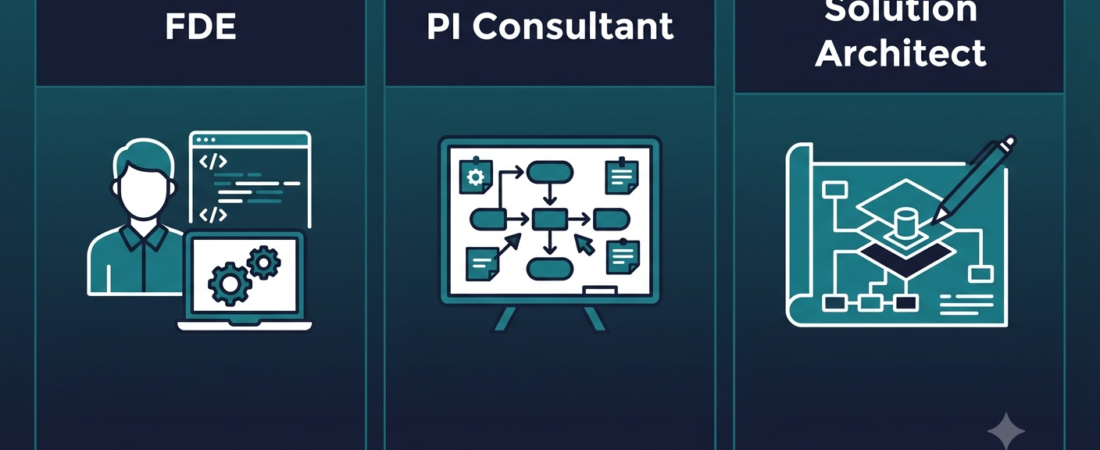
A role Palantir itself created: an engineer embedded on-site at a customer, who writes the actual code for applications running on Foundry, Gotham, or AIP. They break down vague business requirements themselves, build a prototype quickly, get customer feedback, and keep iterating. They’re often involved well past design — through deployment and into early operations.
PI Consultant (Process Innovation Consultant)
Analyzes the current (“as-is”) business process and designs the target (“to-be”) process. On an ERP implementation, this usually happens before (or alongside) system-building: workshops redefine the business process, a Fit-Gap analysis runs, and the result is a document laying out “how the business should operate going forward.” Rather than writing code directly, this role focuses on process design and driving business consensus — closer to the business side than the technical side.
Solution Architect
Designs the overall system structure rather than any one specific implementation technology. Draws the architecture spanning multiple systems and teams, sets the direction for technical decisions, and guides other engineers and consultants as they implement that design. How much code they write directly varies by organization, but the core of the role is “structural design and decision-making.”
Comparison Table
| FDE | PI Consultant | Solution Architect | |
|---|---|---|---|
| Core output | A working application (code) | To-be process design, Fit-Gap analysis document | Architecture design document, technical decisions |
| Writing code | Directly, constantly | Rarely (process/document-focused) | Varies by org, design-focused |
| Focus | “What do we build?” (technical implementation) | “How should the business operate?” (process) | “How should this be structured?” (system design) |
| Customer contact | Very high — constantly collaborates with the business, shaping requirements directly | Very high — drives business consensus through workshops and interviews | Medium to high — works with decision-makers and multiple teams |
| Scope of responsibility | End-to-end, from problem definition through deployment and early operations | Through process definition (implementation handled by a separate team) | Overall structural design; implementation is delegated |
| Success criteria | A working result the customer actually uses | A to-be process the business agrees to and can actually execute | Whether the design meets requirements and scales |
What This Looks Like in Practice
The first difference you notice working alongside an FDE while running Palantir operations is “what actually creates agreement.” In a process-redesign workshop led by a PI Consultant, the to-be process diagram sketched on a whiteboard, and the document that follows, become the basis of agreement with the business — the document gets agreed on first, and the system is then built to match it. An FDE flips that order. Instead of leading with a document, they show a “working screen, right now,” gather feedback on the spot, and fix it immediately — building agreement that way instead.
This approach isn’t always the better one. When you need to redefine a process at the company-wide level, or reconcile the interests of multiple departments, the PI Consultant’s workshop-and-document approach to consensus is still the safer path. In the end, these three roles aren’t competing with each other — they’re roles suited to different kinds of problems. When a vague requirement needs to become something concrete, fast, the FDE approach leads; when an entire organization’s way of working needs to be redefined, the PI Consultant leads; when the whole picture needs to be designed, the Solution Architect leads.
Wrapping Up
FDE, PI Consultant, and Solution Architect aren’t the same role wearing different name tags. An FDE “designs while building,” a PI Consultant “redraws the process and gets sign-off,” and a Solution Architect “draws the structure and delegates.” If you’re coming to Palantir from an ERP background, it’s easier to set the right expectations for collaboration if you think of an FDE not as “a PI Consultant who codes,” but as “one person who rapidly iterates process redesign and system implementation together.”